October 28, 2026
The Behaviors of Finance
So much of the world of investing isn't about finance, but rather it's about human behaviors and how to manage them.
October 28, 2026
The Behaviors of Finance
So much of the world of investing isn't about finance, but rather it's about human behaviors and how to manage them.
6 min read
It was around the Great Recession, or Global Financial Collapse (GFC) in 2008 that I first became aware of the term behavioral finance. To learn investing and manage my own money, I began reading the blog, The Big Picture, written by Barry Ritholtz. I found an ecosystem of financial writers from his blog that I read regularly and many, if not most, of them shared similar insights about investing. Their main emphasis was to spend less than you made and to automate your investing in index funds so you would remove human behavior from the investing equation. It was during this time that I created a new passion of mine and also saw the biggest improvement in my family’s financial future. All because I came to understand that the human brain was not built for the world of finance and managing your human behaviors are key to investing success.
I’ve written before about my hubris when I began my journey to manage my own money. Armed with a little knowledge after reading a few books and listening to Bloomberg Radio, I thought I knew enough to ‘beat the market’. And I promptly lost money.
I then began my real education learning from financial blog writers and eventual podcasters who were more interested in educating their followers than selling them something. Many of the people I followed worked in the financial planning and asset management business, but their blogs told a different story. Almost to a person, their blogs were about injustices that they saw the financial industry carrying out on regular investors. They were interested in warning investors of these pitfalls and educating them about a better way to invest. They didn’t pitch get-rich-quick schemes; rather, they sold a financial plan that involved tried-and-true financial concepts.
My financial life changed. Literally, for the first time in my life I began to understand how real money was created and how the concept of compounded interest over time made this possible.
Through the ups and downs of the stock market from 2009 on, my family followed a process. We didn’t deviate and as the years passed by our financial foundation improved and, for once, we could see how our retirement goals might be achieved.
And then Covid-19 hit. I think it was the fear of the unknown and the reality that people were dying from this virus that made me make the mistake. The mistake which taught me I was nothing more than human.
As I watched the stock market crater in February 2020 and into March 2020, I recalled my experience in the GFC. Back in 2008, after the market had fallen approximately 25%, I heeded our previous advisor’s warning to pull all of our money out of stocks and put it into safer money market accounts. We missed another roughly 30% drop in the market to our enjoyment. We felt so fortunate and smarter than the people who stayed invested and rode the market down to its bottom.
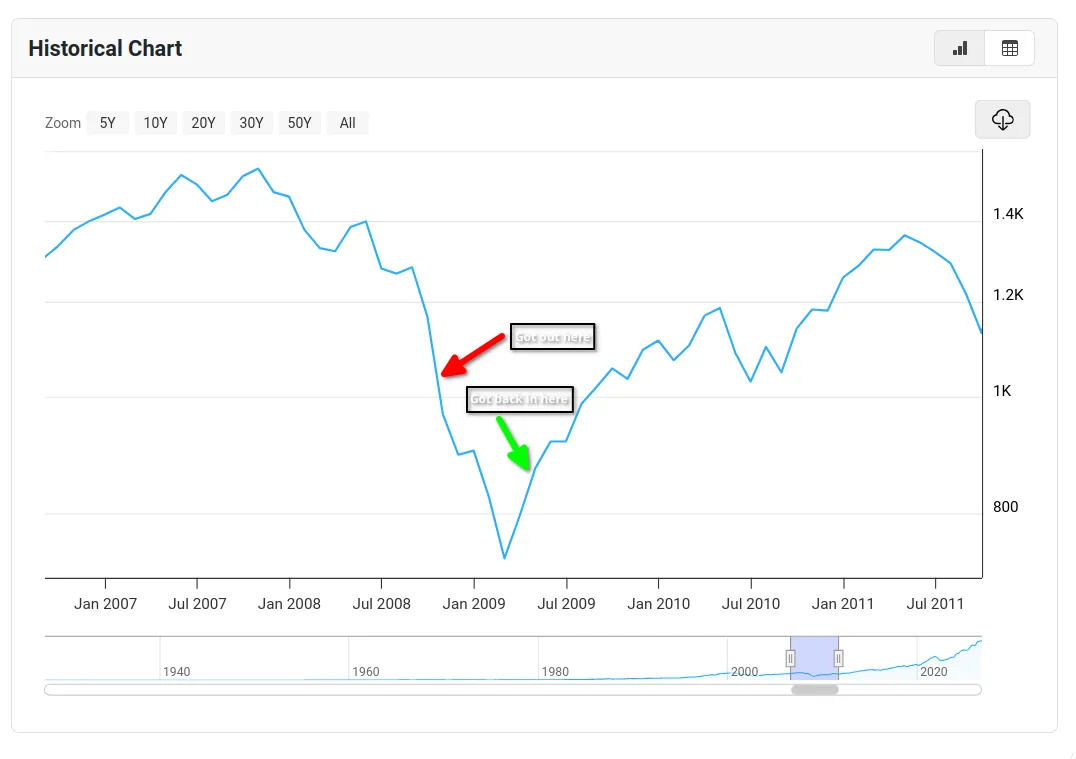
Image from Macrotrends.net
But we also missed the first 20% of the climb back before we got fully invested again in the early summer of 2009. Even though we got lucky and were still ahead, this experience taught us the wrong lesson.
Fast forward to 2020, and I am watching our investments decline. Once we passed 20%, I made the plan about how to respond. Recalling my experience in the GFC, I took note of what a 30% drop in our investments would look like. On March 23, 2020 I took action to protect our retirement investments and moved all of our remaining money out of the market.
And March 23, 2020, was the day the market bottomed! In the following three days, the S&P 500 gained nearly 17% back from its Covid-19 plunge. And I continued to sit out until sometime in late April not certain that the worst was truly over. In the end, we missed out on a rise of just over 24% in the stock market before we were once again fully invested.
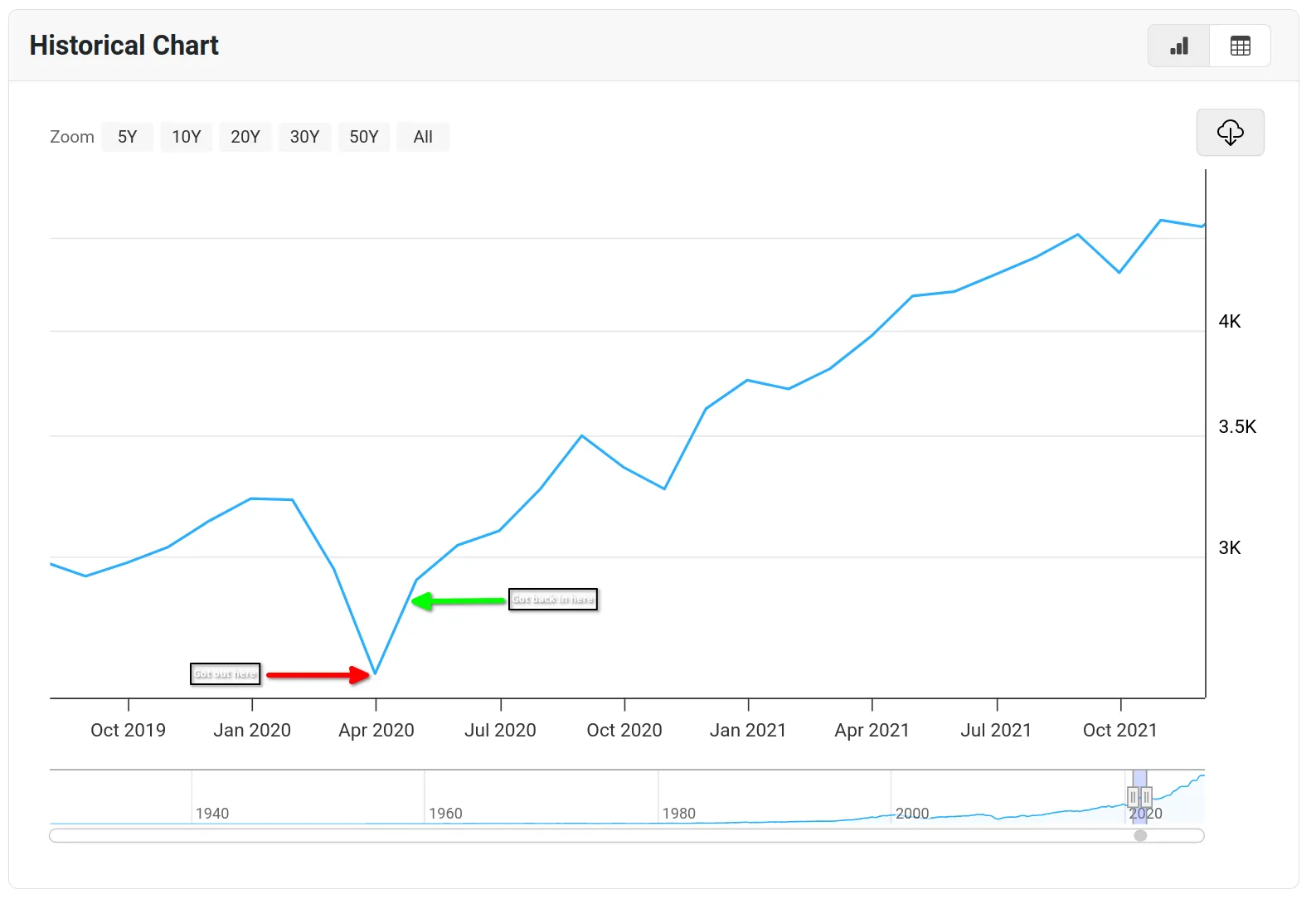
Image from Macrotrends.net
This is when I realized that I didn’t really have a process and I let my emotions get the best of me. Because I recalled how I once survived a market drop, I returned to the same play and this time I got burned. I needed to find someone who would help me implement a true process so I could remove my human behaviors and avoid future costly mistakes.
The 2008 exit felt like vindication. I felt “smarter than the people who stayed invested” which made a lucky and reactive decision (following an advisor’s market call) into a repeatable rule. Hindsight bias is what makes a coin flip retroactively look like skill and it played a key role in my decision making in 2020.
I can’t deny the effects of recency bias in this story, though. When February 2020 arrived, the GFC was the most vivid, most easily recalled experience in my memory, so it dominated my options for a response. The likelihood of it being the right response was driven by ease of recall rather than by research into previous drawdowns and the documented failure of market timing.
I shared this experience with my wife, who I share finances with. That was a difficult thing to confess, to be honest. But she respected what I shared and agreed that we needed to find someone to take the responsibility from me so I wouldn’t have to deal with this situation again. We found a trusted retirement investment advisor who is a fiduciary, so they are legally bound to have our interests at the forefront as they manage our money. After a three-month getting-to-know-us process, the advisor developed a portfolio with us that will allow us to enjoy our goals in retirement while at the same time reducing some risk from our previous investment choices.
We’ve been through various market ups and downs since then, and I haven’t lost a night’s sleep wondering when to move our money or if changes are even necessary. I trust that the plan that we prepared will be the process used to navigate us through any market conditions. I sleep better since I have successfully removed my own human behavior from our investment process.
Ritholtz, B. (2025). How not to invest: The ideas, numbers, and behaviors that destroy wealth—and how to avoid them. Harriman House.
Carlson, B. (2020). Everything you need to know about saving for retirement. Independently published.
Housel, M. (2020). The psychology of money: Timeless lessons on wealth, greed, and happiness. Harriman House.